Tuesday, July 24, 2018

Please support your local climate scientist.

Bear with me here. 

As the lower atmosphere and Earth’s surface warms due to increased infrared heating from (“greenhouse”) gases, the atmosphere destabilizes, enhancing active energy exchange processes (physics) in the atmosphere through some conduction but mostly convection.

In summer and fall, when ocean heat content is greatest, very efficient heat engines known as tropical cyclones may form. These are not the only geophysical phenomena that transport excess heat away from the surface-atmosphere interface. More on that later.

Much debate and claims have been made to suggest that hurricanes will (or will not) become stronger, more numerous, larger, or rainier, as the climate system warms. Maybe all of these, and even faster/slower storms are among the realm of possibilities. And they may occur in new warming regions; physics tells us this.

Scientists don’t have all the answers, but progress is being made. We should not be fixated on a 1.75 m air temperature observation. It’s the entire climate system that matters; that is performing work (in a physics sense). More is happening, at different time and spatial scales, in the oceans and landlocked ice regions that impact sea level rise and ocean pH.

Then there are thunderstorms, extratropical cyclones, polar lows. These systems feed on different energetics, but they still transport energy vertically.

Tropical cyclones are not the only phenomena that matter. Hourly “surface” temperature is not the only marker. We need to work harder to tell a bigger story than what we’ve been doing. Our climate models are providing very useful projections that often foretell dangerous times ahead. And they validate reasonably well in retrospective runs. Can they predict the date of the next cat-5 hurricane to hit Florida? Of course not. But as a scientist who has built computer models, designed instrument systems and field experiments, and diagnosed and forecasted weather phenomena on multiple time and spatial scales, I trust these models more than the economic models that forecast (and never verify) trickle-down monetary flow, or the impacts of corporate and uber-income tax breaks on the average American worker.

Support your local climate scientist. Believe me, and from first-hand experience, we’re not in it for the money. By and large, we women and men are passionate about  using our scientific training to better understand  how the earth system operates, and raising alarm bells where and when it is appropriate, to compel action, if need be.

Paul Ruscher, Eugene, Oregon
24 July 2018


Saturday, March 3, 2018

High School, Science Class, and the AP Exams - Wherefore art though, Earth Sciences?

It is a commonly-held claim that for individuals today to succeed, high school graduation followed by college-level attainment of a degree (or at least career-technical certification) is the path to economic success, as well as a useful pathway into adulthood and society. I won't belabor these claims at this point with reams of evidence. I do wish to take issue with the poor implementation of science in many secondary institutions, as evidenced by state teacher licensure requirements, state testing considerations (particularly for high school students), and inequities in the offering and availability of AP exams, in particular. I do this not to lay blame, but to ask if the status quo is adequate, as we look forward.

The National Science Education Standards, finalized in 1996, formed the basis for a period of reform which resulted in massive changes to standards-based education across the states, including an effort involving yours truly as well as many fine scientists and science educators in Florida. Why, we even got evolution and climate change into the state standards in Florida by 2008, much to the chagrin of organized conservative efforts which are still fighting to remove science-driven teaching from some of the classrooms, thanks to ridiculous bills that have become law in Florida and elsewhere (one such bill is 2017's HB 989) or this year's anti-science bill. If you are interested in such things, Florida Citizens for Science and the National Center for Science Education have lots of material available. In Florida in particular, Brandon Haught has an excellent blog that covers science education and exposes anti-science education attempts. He could use some support!
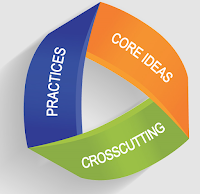
cross-cutting practices, core discipline ideas graphicWith efforts to improve fundamental literacy for our public school students, came the Common Core, and soon an organization called Achieve worked organically with many state partners to develop the Next Generation Science Standards, or #NGSS, which could provide a useful framework for science instructional practice from K-12. These standards amplified and clarified the goals of science education and defined a three-dimensional approach to science education that included disciplinary core ideas, cross-cutting concepts, and science and engineering practices.
They are a phenomenal change and paradigm shift, now adopted by some 19 states and the District of Columbia, including my own, Oregon (disclosure: I served on the state adoption panel and am now a member of the implementation panel for the Oregon Department of Education).

These standards call out (again, as did NSES) new standards among the disciplinary core principles that include a measured balance of material in three major areas: earth and space science, life science, and physical science. Stop for a moment. No biology? No chemistry? No physics? [Not really, keep reading.] Radical idea! Rather, the physical sciences include chemistry and physics; the life sciences include biology, microbiology, and anatomy and physiology. Earth science is finally given its due (a nod came out of NSES but was brushed off in most states), combined with space science. This creates a fundamental problem for states or districts which do not offer earth science or do not have well qualified teachers, or do not even have an ability to have a credential in earth science. Integrated science may suffice, but that usually entails a requirement (for teacher licensure) of only one or two lower division core classes in one of the earth sciences (geology, pedology, climatology, meteorology, hydrology, oceanography, ...) along with a core in more advanced biology, chemistry, or physics classes. That ought to be good enough, right? Well, no. But that is a dead horse I'll jump on another day.

A real problem lies with the expectation that high school students will earn college credit in high school, and the requirement in some states that all students must at least attempt such credits. These can be awarded by participating in International Baccaulaureate (IB) programs, Advanced Placement (AP) classes, sponsored dual-credit with area colleges, or actual college classes taught on their high school campuses. I'll concentrate on AP here, because there is a national standard, and passing scores result in awarding of college credits, based on completion of a high school class and an AP test. Scores go from 1 to 5, and credit is usually awarded for achievement at 3 or higher, determined by states or individual colleges or collectives. Are these credits functionally equivalent to college classes? Do they serve a useful purpose for students in terms of assuring success in college, or quickening that experience for them? In science there is a distinct problem.

The NGSS has provided a paradigm shift in science education for K-12 that includes changing practices as well as changing emphases. Among the changes are the shift from traditional core science classes, biology, chemistry, and physics (although physics is often given short shrift), to one which fits a redefinition I've already addressed above. If one examines the options for students to earn science credit in high school, and the quantitative aspects that occur with it, we find Table 1. I have selected a community college in Oregon (my own), my graduate alma mater (Oregon State University), a smaller liberal arts institution (SUNY Oneonta, my undergraduate alma mater) and a major southeastern Research I university (Florida State University) where I spent much of my time as a professor.

Each of the classes listed on each row of the table is designed as a full-year course, equivalent to one high school credit. These classes may in fact be taught in different ways at different schools, but the credits assigned when achievement goals are reached are quite different; there are fairly universal standards required if a school offers AP options. In nearly every case examined, and in different states, there are two conclusions that relate to NGSS and modern science education practices. There is no way to earn college credit in Earth Sciences, and the amount of credit awarded to Environmental Sciences is far less than those for other science classes, and usually is associated with a non-laboratory science. This disincentive to even offer earth or environmental sciences as an important, quantitative, rich science class is a barrier to students becoming exposed to this material, and potentially opening them to make college choices based on programs that exist to further their own educational objectives. Scholarly work published in journals of the National Science Teacher's Association, National Earth Science Teachers Association, and National Association of Geoscience Teachers, to name a few, report high levels of student satisfaction and engagement with geoscience material. As an example, there are approximately 100 institutions in the United States that offer undergraduate degree programs or options in meteorology, and hundreds more that offer programs in earth sciences with a geology focus. Programs which focus on the hydrosphere (hydrology and oceanography) are fewer in number, but many institutions with graduate programs in all of these areas may have outreach, internship, or research opportunities that can attract students to them, facilitating a hands-on or almost clinical approach to these sciences that help students succeed.

I am advocating here for a rethink on credits awarded. My opinion is that students who take AP science exams are getting too much college credit, and they are also missing out on college credit opportunities because Earth and environmental science options are limited or missing. 

In Biology, Chemistry, and Physics, students who pass a single exam after taking a full term or full year class can earn credits equivalent to a full one year sequence, the equivalent of as much as 1/6 of the entire associate's degree (15 credits out of 90 for the AA). In Environmental Science, however, only one course is awarded at that credit level, and in earth science, there is no credit possible. For years, schools have struggled with how to treat environmental or earth sciences, particularly in states where no instructional endorsement is available, or in smaller rural districts where finding well-qualified teachers in multiple disciplines is particularly harsh. The problems facing those who champion physics education, certainly a foundational aspect of a desirable high school curriculum, are further magnified when it comes to earth and environmental sciences. Similarly, liberal arts non-science classes typically do not bestow credit equivalent to 1/6 of an Associate's degree.

In many instances, earth science is taught and relegated to those students who are deemed not to be college-bound, if it is offered at all. In my own case, I was an honors high school student in New York (decades ago) who was not given a chance to take earth science, even though I wanted to. Guidance counselors at the time moved freshmen students with "low achievement" in middle school into the freshman earth science class - it was not open to advanced students. I had to take anatomy and physiology as my 4th high school science class. It was ok, but didn't help me formulate a better understanding of options in earth sciences. Even in admissions decision-making, earth science or environmental science classes sometimes (often?) do not "count" as laboratory sciences, while the traditional "big-3" do, regardless of what the nature of the science class (or lab, if available) is at the high school attended. The landscape imagined in NGSS demands that disciplinary core ideas provide some structure and framework for how to reimagine science instruction. At the high school level, there are many options (see the Appendix K examples in NGSS, for example). But in analysis done by the Oregon Department of Education, there were 19 missing standards in the earth sciences, and another dozen or so in physical or life sciences, as Oregon moved from its earlier (2009) standards to full NGSS adoption.

Liberal Studies approaches to Science Education

Science electives are typically part of any BA or BS degree, and require students to complete a minimum of coursework in Mathematics and Science (usually at least one of the latter with a laboratory component). Courses like "Rocks for Jocks" and "Digging Dinosaurs" are commonly offered to meet the demand for this requirement, and they can be excellent options. But they also often can be deployed for mass audiences without opportunities for students to engage in real inquiry. That prompts a question:  What now for Earth Science?

Elective courses are available across the gamut - committed educators often taking on extra "preps" to make them work.  But commonly we also find:

  • Inadequate laboratory facilities to foster engagement
  • Inadequate understanding of earth science as a true "hard science" by college admissions and high school guidance counselors, and inadequate knowledge of career potential across the geosciences.
  • Key societal aspects of science implementation are foundational to earth sciences, including renewable energy, understanding of climate change, public health and environmental pollution, geophysical hazards, and even aspects of environmental justice. But teachers often state they don't feel like there is enough good material for them to use, or they would like to learn more about them so that they can deploy good methods in their own instructional practice.

What now for Environmental Science?

What an opportunity for an integrated science capstone course with aspects of life, physical and earth sciences! This could be a great 4th year of science course in high school. Imagine students becoming Data Scientists by mining data off government web sites, or measuring their own data and involving themselves in collaborative research, using past data gathered at their own local sites, or working with others across the GLOBE. That does prompt a shameless promotion to the GLOBE program, and its fine work including connectivity to NGSS.

A longtime colleagues (and lobbying mentor whose excellent blog Bridge to Tomorrow is linked here) from our 2006-2008 work, Paul Cottle, championed the notion that Florida needed to spend $100 million on teacher professional development to successfully deploy new standards in Florida. That proposal went nowhere, and the efforts to successfully implement instructional practices supported by research in science education continue to be thwarted in many states and districts. In addition, even in the states where changes are implemented, budgetary support is often lacking to institute the reforms. The problem is particularly stark in Oregon, the state with the lowest number of instructional hours per week in elementary science, and very poor laboratory facilities and dearth of well-qualified science teachers according to what NGSS is expecting.  Teacher preparedness for implementation of NGSS will require a seed change in deployment of funded and useful professional development for existing teachers, better certification options particularly for teachers of physics and Earth science, and effective professional learning communities that could work to implement practical and solid student opportunities across the sciences, including perhaps increased opportunity for high school students to earn college credit in real college-level science classes.

There are resources available if you are interested. Here are a few good ones from whom I've gleaned much good information over the years:
It is my hope that committed science educators will advocate for precious time and resources in their states and across the nation, and not just within their discipline organizations. As an earth scientist, it is insufficient to work within a narrow group of geoscience professional organizations, we must expand our work across the spectrum of science educators. The spreading of "alternative facts" informing our young minds is a corrupting influence on student understanding of how science works in fundamental ways.

3 March 2018 Paul Ruscher, PhD, FAMS, Eugene, OR

Opinions expressed here are attributable to me and not my employer or affiliated professional organizations.


Thursday, February 15, 2018

A Science-Based Approach to Gun Control

A Science-based Approach to Gun Control

The tragic St. Valentine’s Day Massacre at Marjory Stoneman Douglas High School in Parkland, Florida provides a tragic opportunity to revisit, once again, the issue of gun control. A scientific lens can provide a rational framework for such a discussion, instead of dismissing this as “too soon” as we have heard from so many.

In these times across the nation, many in the public are skeptical of science and scientists. This skepticism is not healthy and is based on a narrative being presented that focuses on scientists as egghead experts, who don’t listen to or accept counter arguments. This is blatantly untrue. Scientists love debating when the issues are data-driven. But put a scientist in a debate with a politician, and you learn nothing, at least about science. You do learn something about dog whistles and raw meat, which is a social science.

We in the science community have faced these times before, with lead poisoning, tobacco and its relationship to lung cancer, acid rain and air pollution, vaccines as preventative measures for disease, the causes of AIDS, and climate change, to name a few. Each time, the scientists have proven to be correct, and it is often in the US that these scientists face the most skeptical public.

If you are still reading, perhaps I can convince you about how science can inform the discussions that will be coming. First, we need to recognize that a very powerful lobbying organization known as the National Rifle Association (NRA) pressures elected representatives to only advance laws that enable and expand gun ownership, and strive to stop any attempt at gun control, hiding behind a very flexible interpretation of the Second Amendment to the Constitution, but not science. Many of the same proponents to strict interpretation of the Constitution and Bill of Rights do not extend that interpretation to the 2nd Amendment, which addresses a right to bear Arms. Single-shot flintlock or matchlock firearms, in other words. But, I digress into logic – let’s get back to science.

Where does science come in? Science enters the argument here because in science, an understanding is developed by experimentation and measurement. The first problem with science and gun control is effectively a ban on research by the #DickeyAmendment. Congress has passed a law that prevents public funds for the study of gun violence in the nation. Thus scientists who wish to study the phenomena, are left to their own funds or funds set up by organizations who have a clear agenda; thus bias may be implicit in the research. Although some research has been published recently (OIM and NRC 2013; Sumner 2015) in peer-reviewed journals, researchers who wish to study public health aspects are stymied by a lack of research-quality data. Remove these unnecessary restrictions! The only reason they exist is because their proponents are fearful of the likely findings.

Before we go further into this particular argument, let’s take a look at how science informs engineering and public health as examples. Engineers are in effect scientists who are interested in making things practical or useful. Engineers take an approach towards understanding how processes are created or limited, and engineers will design and build to ensure proper function over an array of conditions, including costs and benefits. This means studying which aspects are prone to failure. The engineers put their work into practice to ensure that the worst-case scenario does not lead to catastrophic failure. They calculate the likelihood of failure of their design, and typically build to a higher standard as a precaution. They test their work with models. Policies are developed to license engineers and require routine and ongoing inspections, looking for points of failure. Physics and materials science provide a lot of background for this important work.

In the public health arena, we have another example of science-based policy. We are well-protected when the vast majority of the population is vaccinated against the most common and serious illnesses that can rapidly spread in a vulnerable population. How do we know this? We know because scientists have examined the biological organisms that pose risk to humans and the ecosystem, and how outbreaks and pandemics occur. By deploying common-sense measures to control contamination and reduce harmful organism spreading, public health specialists minimize risk to susceptible populations and the public at large. Biology, chemistry, meteorology, and hydrology informs much of the science that evolved over time to create effective protective measures. These scientists help to define minimal protective standards; again, using an abundance of caution to be sure that effective protection is deployed. These are not set to be at the cheapest level, rather, they are set to ensure maximum protection among the public!

With regard to gun control, we often hear about the role that mental health plays in the perpetrators of mass gun violence. That is undoubtedly an important component.  However, in order to raise this as a controllable issue, we must have a valid mental health assessment and reporting mechanism in place. Ask any mental health professional if science can provide an accurate prediction of future behavior, and they will tell you there is much uncertainty. And given the lack of adequate mental health assessments and care across the nation, and enabling legislation that strips away states’ rights to keep guns away from those who have been judged to be at risk, we can eliminate this argument right away. Scientists will tell you it is impossible to invoke an effective countermeasure here at the present time.

Scientists who wish to suggest practical gun control strategies will then likely recommend that there should be limited availability of firearms, to ensure the safest situation for the pubic. But wait, there’s more.

Ammunition kills or injures, not the gun or the person who pulls the trigger. The larger, faster, more massive, or more numerous the ammunition is, the more likely a well-aimed discharge will result in the desired effect, namely to stop, wound, or kill someone or something. Medical doctors will tell you how a round of ammunition can inflict injury or death, it is not a pretty description so I won’t repeat it here. Pediatricians have become alarmed at the high rate of gun injury and deaths from firearms that are not kept away from children, but their attempts to study or mitigate this (for example, by asking questions of their patients or family members about gun availability) are against the law in some states. Since doctors take an oath to cause no harm, they would advocate for minimizing speed, size, and number of rounds, to reduce injury, and to reduce the number of humans with the capacity to kill or maim.

The most sensible way to protect the public, and children in particular, from a scientific perspective, is to reduce access to high speed delivery of ammunition (the firearm), fast or massive (high caliber) ammunition, or large ammunition clips, and eliminate automatic or semi-automatic weapons (legal semi-automatic weapons are easily converted to illegal automatic weapons).

Scientists will tell you it is time to create reasonable limitations based on sound science. And nearly 90% of the general public agrees.

Science informs public policy makers in many ways. With regard to gun control, give the scientists the tools they need to study gun violence in the USA. And listen to them when they tell you that there are ways to reduce gun violence. Each individual tragic event can be argued in many ways, but collectively, it is abundantly clear that we do not have the capacity to solve this nationwide problem without tackling gun control as a science-driven public policy issue.

A useful starting point would be federal legislation to ban assault rifles and large-capacity ammunition magazines for public ownership. Provide a cash incentive for weapons and ammunition to be turned in for a time period, like Australia did after a mass shooting there in 1996 (Calamur 2017), which has resulted in 0 new cases. After the collection period, institute effective penalties for violations. Such actions would have no bearing on hunters or target shooters, but would be an anathema to those who seek the thrill of firing that machine gun. There are things that are best left to the experts in law enforcement and the military. And these two organizations should ensure that the weapons that they use, and seize, are under strict control.

Some science is not hard. But extending public ignorance of the importance of science to society is really hard for us scientists to take. So, get the lead out, Congress and state legislatures. Oh, yeah, science has proven that lead ammunition poses risks of contamination in the environment, so the laws recently enacted to forbid the banning of lead ammunition is patently ridiculous, too.  Scientists, and mechanics, will tell you, “You can pay for it now, or pay a lot more for it later.” Listen up, everyone.

Dr. Paul Ruscher, Dean of Science, Lane Community College, Eugene
Fellow, American Meteorological Society
15 February 2018

External references cited:


Calamur, Krishnadev (2017). “Australia's Lessons on Gun Control”. The Atlantic, October 2, 2017, retrieved online from https://www.theatlantic.com/international/archive/2017/10/australia-gun-control/541710/
Institute of Medicine and National Research Council (2013). Priorities for Research to Reduce the Threat of Firearm-Related Violence. Washington, DC: The National Academies Press. https://doi.org/10.17226/18319.
Sumner, Steven (November 3, 2015). "Elevated Rates of Urban Firearm Violence and Opportunities for Prevention"(PDF).  Delaware Department of Health and Social Services. Retrieved July 2, 2016 from http://dhss.delaware.gov/dhss/dms/files/cdcgunviolencereport10315.pdf .


Friday, February 2, 2018

Honoring Dr. Thomas A. Carney

I'm back. It's #BlackHistoryMonth and I want to take the time to honor a man who had a profound influence on me as a science educator, the late, great Tom Carney, who was a great positive influence on my early teaching career. It's an important time to remember those who have influenced us personally, I firmly believe. He is one of the celebrated African-American meteorologists recognized in the 2005 Passport to Knowledge project.

It started as I was in the midst of a 3-yr run of temporary full-time faculty gigs while I foolishly tried to complete my PhD at Oregon State University. It started in 1983-84 at Texas A&M University, moved to Florida State University, and then Creighton University, before I realized I had to be "present" at OSU to complete (hint to those working on their doctorates - stay focused on the work at hand and develop a good completion strategy!). I knew I had some ability to teach, having completed the "College and University Teaching" minor for my PhD requirements, and having taught some of the upper division classes for BS majors. But was a life as a faculty member really going to work for me?


I met Tom as I arrived in Tallahassee in August 1984 and we immediately bonded. We were both interested in instrumentation and observations, and the atmospheric boundary layer. Tom mentored me in particular about developing rapport among the relatively small seniors, new graduate students, and Air Force "basic meteorology program" students. That semester's group consisted of about 15 dedicated students (a far cry from the 50+ that were taking synoptic 1 by the time I left FSU in 2012!). He schooled me in teaching strategies that helped me to bridge the gap between physical and dynamic meteorology into synoptic meteorology (I really have been a boundary layer/turbulence guy even though I was often hired or appointed to teach synoptics!). I began to view synoptic meteorology (properly I would say) as the place where students begin to appreciate the foundational work done in physical and dynamic meteorology. I remember years later meeting a student in Doak Campbell Stadium at a big game and he thanked me for teaching him dynamics in synoptics! As I thought about this more, and began to touch base with the likes of Fred Sanders, Lance Bosart, Howie Bluestein through UCAR workshops and AMS meetings, I would often go back to my conversations with Tom.

My initial stint at FSU lasted only a year before I was off to unemployment back in Texas, where my wife was building a thriving midwifery practice. But there wasn't much for me there, so I applied for a job at Creighton, which did not turn out so well for me (and so many others). Back to Corvallis, to complete the PhD in less than a year and then a postdoc, and FSU opened a new position, so I interviewed again, and found a good place for the next 24½ years.

By the time I returned to FSU in August 1988 (8/8/88 was my lucky hiring date), Tom was already quite ill, and sadly he succumbed to his illness a short time later. I was surprised that as a new faculty member, I was touched and honored when the chair approached me to help arrange his memorial service at FSU. After all, there were a dozen other members of the department, but I was happy to do it, and meet his family. Tom was a unique individual who I will never forget. He helped instill in me an attitude of inclusiveness as a parent, and educator. It is by his own grace and dedication that I worked hard to reach out to communities that were not well represented at the time (1980s) in Meteorology, working with AMS to create and implement scholarship opportunities for undergraduates. 

Let's not forget those who influenced us to make the world a better place. 

Thursday, February 1, 2018

Six months ago ... looking back and looking ahead

31 January 2018 - 1 February 2018

In spite of the confusion of the political world around the apparently quite corrupt Trump administration and its congressional supporters revealed in just the last couple of days, I've tried to spend some time reflecting recently.

You see, six months ago to the day, I was attacked. Not verbally by social media or email (that happens to many of us who communicate about science), bult by robbers at a pharmacy I frequent. These three young men took it upon themselves to steal narcotics from the staff present, and as they got rough, I, the next customer in line, intervened by calling out a robbery alarm to the rest of the (grocery) store. Then they came at me. I guess. I recall vividly the first blow to my temple, which resulted in me hitting the ground hard, head-first. I seem to recall a second attack as I got up ("You fool, stay down!" is what I wish my conscience had told me, rather than "Do something! People are getting hurt!"). Which again resulted in my head hitting the floor, hard. Another customer says I got up and was body-slammed a third time. No recollection of that one.

The police have not been able to identify the perpetrators. The press covered it barely (there is a string of pharmacy robberies going back a few years with often good police and press cooperation resulting in some helpful identification and prosecution, see) †. But this robbery was not reported as a strong-arm robbery, no. It was reported as a "nobody was hurt attempt" to acquire drugs without prescriptions. Not for personal use. I've been told by some that it is to manufacture something called purple drank. And the store will not show me the video of the attack, captured by its brand-new surveillance system, as they are apparently afraid of some liability; every request I made goes to some insurance person in Little Rock or Arizona or someplace. They were nice enough to give me a $25 attaboy gift card to the store and recommend a small sum in appreciation (but the latter only after I agreed not to sue for damages), and some chocolate milk to wash away the effects of pepper spray in my throat. Yeah, they had pepper spray, too, and used it extensively on at least two people (one of the pharmacy employees and me). Again, not reported by our local paper, which gave scant coverage to the other pharmacy robbery across town the same night. I wonder if they were related events?

So where am I now? I received a #concussion, some would call it a traumatic brain injury or #TBI, but even that is in doubt. I've been in intense pain, experienced severe auditory disturbances which trigger other symptoms, confusion, irritation (I'm usually a pretty happy guy, ask anyone), and in general frustrated. I could not spend the holidays in celebration with family (particularly the grandkids), because the sudden noise and/or multiple conversations were too intense for my feeble recovering brain to sort out. I got panic attacks for the first time in my 62 year old life. I even went to the ER for one of them, thinking I was having a heart attack. And through all this, my family and my care team has stayed steadfast in their determination to help me. And they are. What is most troubling is the fact that this has surfaced, or resurfaced, my #depression and #anxiety.

My place of employment has been wonderful through this, providing me with access to not only urgent immediate care but also space and time to heal, with a reduced workload. However, with no short-term disability coverage, I was forced to use scores of hours of sick leave and vacation time to cover lost wages. This gets me wondering about society as a whole, and the large number of people who work for minimum wage (or less) and get sick or have a loved one getting sick. How do they cope? That is an issue for all of us to consider on another today.

I have had the fortune of having a loving wife for 42+ years now, and we've had 11 children (including adoptions) and 3 foster kids. Our kids are having kids and I now have 12 grandchildren. We have a gigantic multicultural family, and I'm so lucky. But my depression and anxiety roots back to several tragic events going back into my early years, including the loss of one of my children to HIV/AIDS-related lymphoma, and the loss of one of our foster kids just as we were on the cusp of adoption proceedings. Each time I was gripped with sorry, anger, self-hate, etc. That has now resurfaced in different ways as I continue to recover from my injury and my latent issues.

Counseling has helped me a great deal. Also helpful has been the public sharing of experiences on social media (#Twitter, primarily; I seem to not be very tolerant of what I see on my #Facebook feed these days). I was awakened also by the metoo hashtag which I won't use here to make any claims as it minimizes the far worse situations women have faced compared to me. As a career meteorologist and climatologist faculty member, I'm drawn to posts by @wx_becks @SnowHydro @weatherdak and others, and the experiences of the many who have faced bullying, exploitation, harassment, molestation, rape, and discrimination even in higher education, where theoretically, everyone involved is supposed to be somewhat intelligent. Gee I wonder if intelligence and compassion are correlated? You are all so brave and your voice empowers many. You should know that.

As I am now a dean, I'm responsible for my division and its over 80 employees and over 2,000 students who take science classes at my college each quarter. That is a heavy burden. My colleagues and others at the college have been great and supportive, and I'm on my way back to gainful full-time employment. I can feel it. I will not let #depression and #anxiety win. The campaign on 31 January on social media related to #mentalhealth was very cleansing and freeing for me (I actually saw it first on William Shatner's twitter posts. So I'm ready to start sharing more. I had left my blog alone for months because of a combination of shame, worry, perhaps even fear of the future. I'm ready to embrace the future, and thanks everyone who has shaped this recovery to #positivism. Even if our political arena does not seem to embrace compassion and caring in these times, there are still heroes out there. You know who you are. And I thank you!

PS - I was in a rush to complete this before tomorrow, for it is Groundhog Day tomorrow, and that is important to any meteorologist, of course! I imagine the President will see his shadow, too, for winter is nigh.

PPS (in the interest of full disclosure) - Some Nunes edits were made to correct grammatical errors and syntax here on 2/2/18.

Saturday, September 30, 2017

Public education at risk

If you are reading this, you probably know me as a passionate advocate for public education. I went to public school (K-12) in New York. My college days were at public universities (SUNY/Oneonta, UCLA, Oregon State). I've taught as faculty in public sector, too (Oregon Coast CC*, Texas A&M, Florida State, Montana State*, and most recently at Lane CC). I majored in Meteorology/Atmospheric Sciences at each level, and took minors in mathematics, water resources, and then college and university teaching.

I also taught in private higher ed, at Linfield* and Creighton (*denotes adjunct positions). I was a high school math tutor, homeschooling parent, private childbirth educator, and as an academic dean I am still a creator and deliverer of teacher training to educators from the public/private/non-profit sectors. I've done PD across the USA and internationally in Canada, France, Jamaica, Jordan, Scotland, Trinidad & Tobago, with 3 North American tribal teams, and co-led teams that also trained in Mexico and Australia on my projects. I designed and co-taught science education classes for the FSU College of Education, and collaborated with the University of Texas' UTeach program.

I know something about education. Not just science education. Across the US, public education is under attack, and both Democrats and Republicans are complicit. Below you'll find a copy of a post from a friend who is a member of the NY Chapter of BATs (BadAss Teachers Association). Fans of public education should pay attention to them. They are calling out so-called reforms that are nothing more than attempts at privatization support for/larceny of public sector $. Don't believe me? Examine what's happening with state governments doing outside contracting in transportation, health care, prisons, social work, probation and parole, security, in your state, red or blue. There are BATs chapters in every state.

And this disturbing trend is showing signs of gaining traction in Oregon. Under the guise of addressing inequitable access to higher education, some legislators and education leaders are promoting, effectively, substandard versions of college courses by teachers who aren't certified. Sound familiar? Sounds like the for-profit model to me, that failed so many at ITT, CorinthianTrump U, and others. Are these classes comparable to what is offered by regionally-accredited institutions? I've looked at some, and it is a very uneven landscape. Rural districts are indeed very poorly served in terms of access to college credits for high school students, but wholesale adoption of the limited existing options should be examined carefully. I'm for development of cohort mentorships, fairly compensated to all participants and collaboratively designed rather than imposed, to built up repertoire and experience, for preservice and practicing teachers in underserved areas. Are these articulable and transferable? And is advanced credit something that should be available to all? 

Now, let's hear from the NYBATs:

Standing Up for Teachers NY BATs!!!  

30 September 2017 - From their Facebook Page.  The SUNY Charter School Institute is one of two agencies in New York State that grants and oversees charters at schools. Earlier this summer, the Institute proposed a change to regulations that would allow charter schools to self-certify teachers. It is shocking that a proposal has been presented to the Trustees from within SUNY to abrogate the high standards for some seeking to be teachers. These changes in regulations would undermine the teaching profession throughout New York State. All New York Students deserve a highly qualified and fully certified teacher.
Imagine that we were presented with a complaint that a health care network couldn’t find enough licensed doctors to hire for their urgent care centers. Its solution is to request authority to establish its own training program, which provides substantially less instruction time and dispenses with all the qualifying exams. This is the medical equivalent of the SUNY Charter Schools Institute proposal. It is deleterious, deeply flawed, and unacceptable.
The full SUNY Board of Trustees does not plan to vote on this item, but rather will defer to a vote by only the Charter School Committee. It is our understanding that the committee intends on hearing this item at their October meeting. The public notice and agenda have not yet been posted, but the meeting will be on October 11th, at SUNY Global Center, 116 East 55th Street. 
Meetings are generally in the morning. You can check on the SUNY Board of Trustees website for announcements, or contact my office next week. Please plan to attend to make it clear to the committee that all children deserve a fully and properly certified teacher. There will not be an opportunity for public speaking.

Wednesday, August 9, 2017

On scientific matters, who's minding the store at the Executive Branch?

Well, it turns out, nobody! Thanks to ongoing work by the Washington Post and the Partnership for Public Policy, the Trump Administration has failed to nominate 354 of 577 Executive Branch positions that require Senate oversight (over 60% of these positions are vacant!). Now Senate oversight has not meant much in the first 200+ days of the administration, but we often hear how President Trump and his supporters lament Congress' slow pace at approving his appointments, with criticism often aimed at the minority party.

It turns out we have real, actual data (truth!) to indicate how things are going with those appointments. I've attempted to identify the remaining appointments that are related to science (including environmental areas) posts from this Washington Post Powerpost, and was astonished to find 75 vacancies with not even a nominee!

75!

I suppose one could argue that it is best not to have Mr. Trump's imprimatur on these positions, since so far he has given us some real scientifically-credible winners like Betsy DeVos, Scott Pruitt, and Rick Perry at the tops of their departments, with even worse picks beneath them in the few science positions that have been filled.  But with important budget and policy decisions looming inside the Beltway, and virtually no-one with scientific expertise advising the high-level administrators and the President, one has to wonder about our present administration's taste for truth in decision-making. I've assembled all of the data for these missing government scientific administrators in a spreadsheet, valid as of 8/8/2017, so far as I can tell. I left out a bunch that have science components, as well, and made notes where appropriate on some I retained on a second pass. And don't get me started on the advisory groups and commissions that are being dismantled, who do the real honest work on reviewing important peer reviewed science on climate, the environment, public health, energy, and nuclear proliferation.

I wonder if one could argue the classic Trump line that these are superfluous and redundant positions, and so government is better off saving these $ and leaving them unfilled, just like all of these non-competitive, redundant, and unnecessary regulations that are being torpedoed that we keep hearing about.  Why, the entire White House Office of Science and Technology Policy has been closed - winning saving$ there!  [You can follow the #OSTP diaspora on Twitter!] This is the same office that under Vice-President Al Gore's leadership helped to create the GLOBE program, an organization I have worked with for nearly 20 years. GLOBE, and my involvement in it, will continue for the time being, thanks to bipartisan support and agencies such as NASA, NSF, and NOAA. But I truly wonder about the health of the public's attitude towards science and science literacy/education at this moment in time in the USA. I feel like going into the kitchen and spatchcocking something.

But before I do, let me thank those hard-working civilians and contractors who carry out the important scientific work regardless of partisanship issues; many have passed through my labs and classes here at Lane, at FSU and elsewhere. And I do get it, and respect, those who opt to leave federal service when the distaste becomes toxic. You are all our heroes!